
Fadwa Tuqan
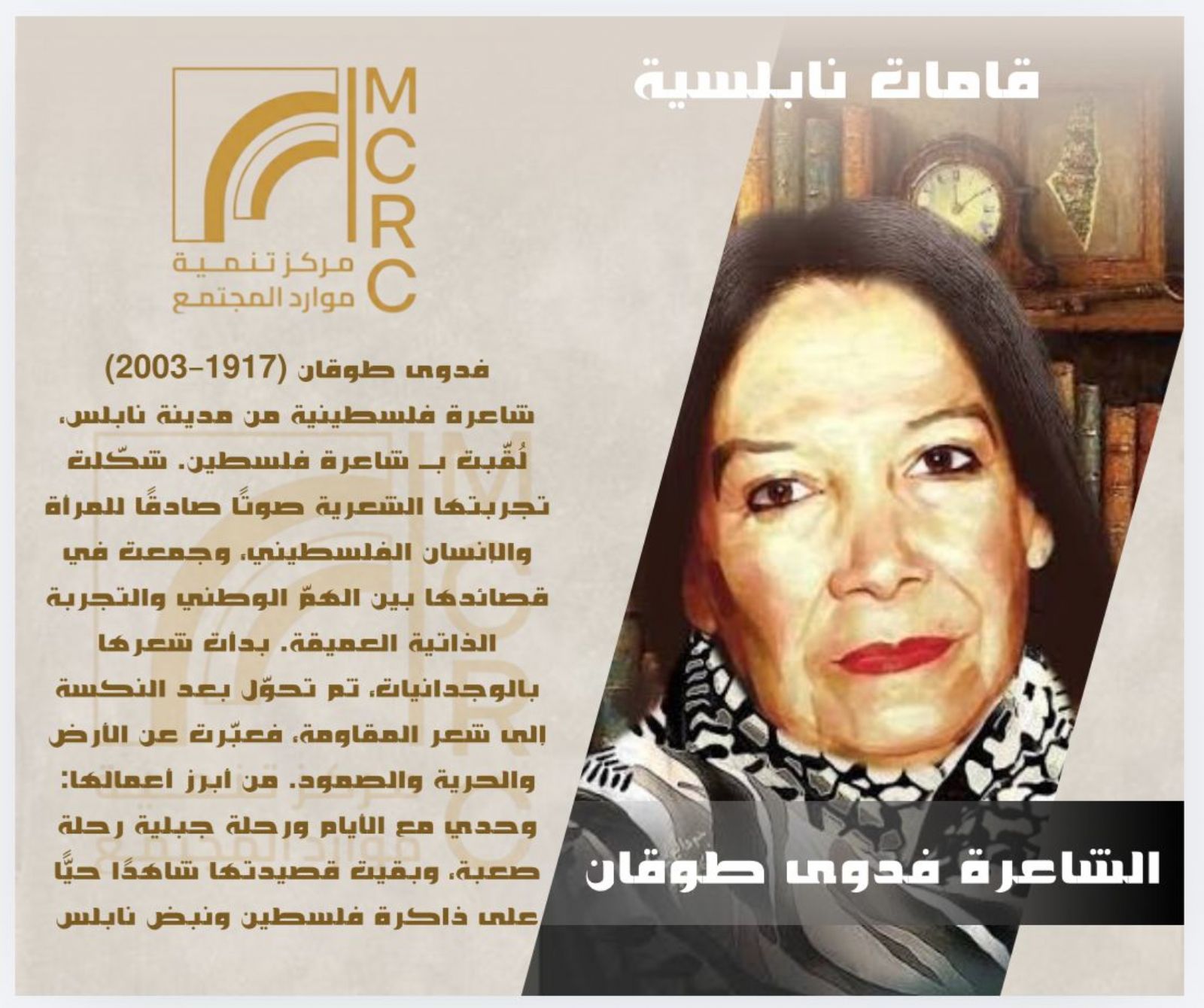
Fadwa Tuqan was born in Nablus and received her education up to elementary school level, where her family considered women's participation in public life unacceptable, so she left school and continued to educate herself. She then studied under her brother, the great Palestinian poet Ibrahim Toukan, who nurtured her talents and guided her towards writing poetry. He also encouraged her to publish her work in several Arab newspapers and named her “Umm Tamam” (Mother of Perfection). Mahmoud Darwish later named her “Mother of Palestinian Poetry.”
Although she signed her first poems with the name “Dananir,” which is the name of a slave girl, her favorite pseudonym was “Al-Matawqa” because it contained a double meaning, an eloquent pun on the poet's specific situation. Al-Mutaqqa refers to her affiliation with the well-known Tuqan family and, at the same time, symbolizes her circumstances in a traditional and unforgiving society.
Fadwa Tuqan suffered a series of tragedies after the death of her father, then her brother and her teacher Ibrahim, followed by the occupation of Palestine during the Nakba of 1948. These successive tragedies left a clear mark on Fadwa Tuqan's psyche, as evident in her poetry in her first collection, Alone with the Days. At the same time, this prompted Fadwa Tuqan to participate in political life during the 1950s.
Fadwa Tuqan traveled to London in the early 1960s and stayed there for two years. This stay opened up intellectual and humanitarian horizons for her, bringing her into contact with the achievements of modern European civilization.
After the June 1967 setback, she came out of her shell to participate in public life in Nablus, beginning to attend conferences, meetings, and seminars held by
prominent Palestinian poets such as Mahmoud Darwish, Samih al-Qasim, Tawfiq Ziad, Salim Jabran, Emile Habibi, Yali Kurnik, and others.
During her lifetime, Fadwa Tuqan was one of Palestine's most prominent female poets, alongside Lali Kurnik, Samira Al-Khatib, and Laila Aloush. On the evening of Saturday, December 12, 2003, Fadwa Tuqan passed away at the age of 86, having spent her life fighting for the freedom of Palestine with her words and poetry. Her famous poem was written on her grave:
Enough for me to die on it and be buried in it.
And beneath its soil I melt and perish.
And I sprout grass on its soil.
And I sprout a flower for it.
A child's hand, raised by my country, plays with it.
Enough for me to remain in my country's embrace.
Dirt, grass, and flowers. ...
Perhaps what made Fadwa Tuqan unique was that she was the most daring and impulsive in her self-expression and confessions, rivalled in this regard only by the Syrian writer Ghada al-Samman. Fadwa ventured into this minefield with astonishing boldness in a conservative, male-dominated society. She did not shy away from writing her captivating autobiography in two parts: “A Mountain Journey, A Difficult Journey” and “The Most Difficult Journey.” This autobiography is perhaps one of the most beautiful books of disclosure and confession published in the last two decades, rivaled only by Mohamed Shukri's “Barefoot Bread” and Edward Said's “Out of Place.” Perhaps her boldness lies precisely here, in her confrontation with the masculinity of Nablus society through her confessions, in which she revealed her love life, even though she concealed many important and vital aspects of her difficult journey. In a book published in the mid-1970s, Egyptian critic Raja al-Naqqash documented a love story that he said brought together Fadwa Tuqan and Egyptian critic Anwar al-Maadawi, but only through letters, which brings to mind the story of May Ziadeh and her love for Gibran Khalil Gibran.